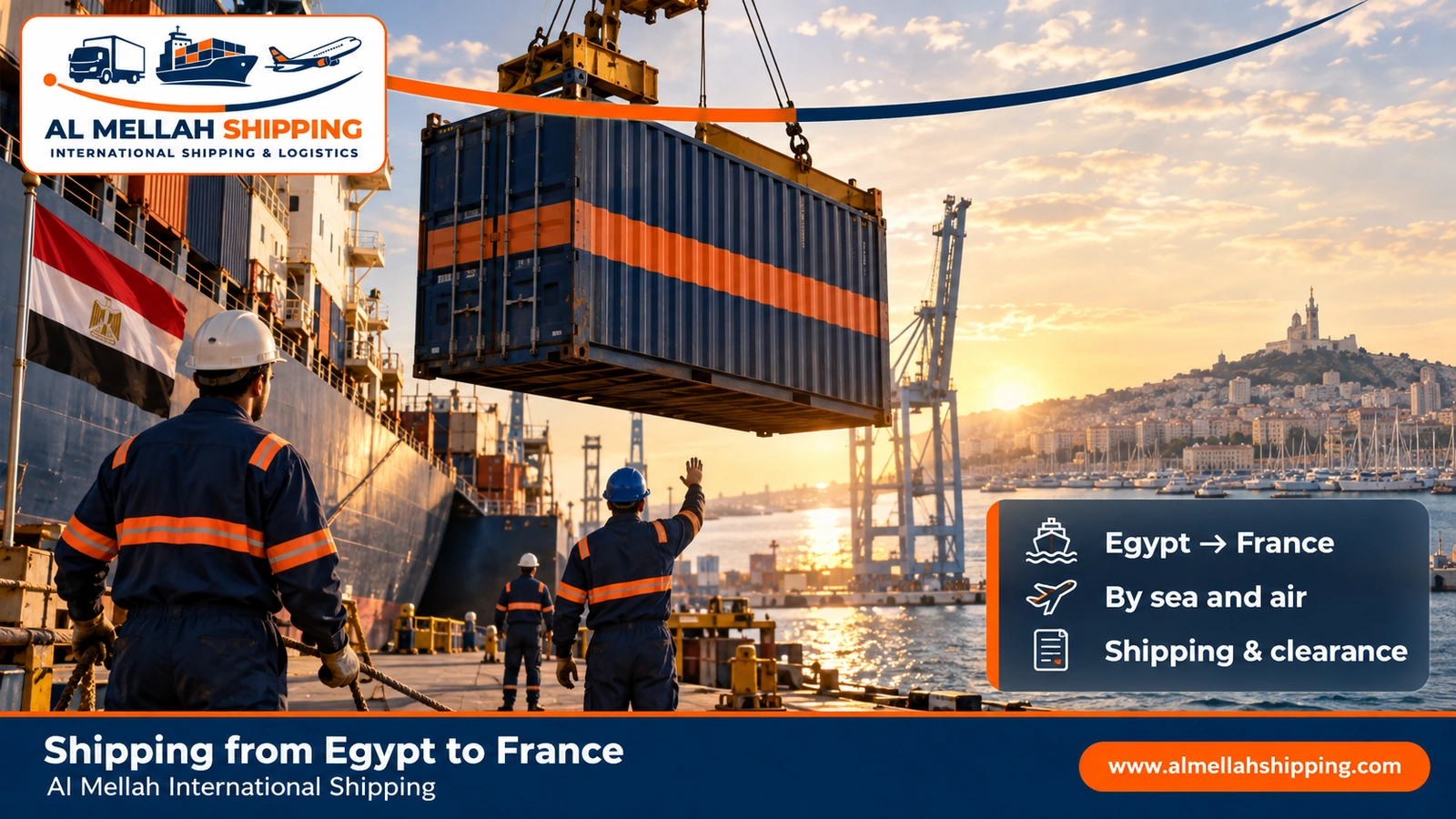
Shipping from Egypt to France — The shipping route from Egypt to France is clear and well known, but its details are what make the difference between a shipment that arrives on time and one that waits at the port at a daily cost. The usual duration is 15 – 28 days, and this short guide explains what you need to know before you sign.
The route and ports used
By sea from Alexandria across the Mediterranean to Port of Marseille or Le Havre, with inland distribution from both or onward to EU countries. It is advisable to confirm the sailing schedule and port conditions before loading, because dates change with the season.
The duration depends on the sailing schedule, port conditions and completeness of the customs file more than on distance.
Shipping options: full container, consolidated or air?
The practical rule: If your shipment’s volume is close to a container’s capacity, having it to yourself is cheaper per unit and more private. If it is smaller, consolidated shipping is better because you don’t pay for empty space. And only choose air if the cost of delay is really higher than the price difference — which is usually large.
| Option | Best for | Advantage | Trade-off |
|---|---|---|---|
| Full container | Whole home · bulk cargo | Sealed and cheaper per unit | Needs a large volume |
| Consolidated shipping | Medium and small shipments | You pay only for your space | Waiting for consolidation to complete |
| Air | Documents · samples · urgent | By far the fastest | Far more expensive |
The customs file and requirements
France is in the European customs union, so the tariff is unified across the union and French VAT is added. The documents include the European customs declaration. The goods’ classification is what determines the rate applied, so describing them accurately on the invoice helps you rather than harms you.
Why are shipments delayed at ports?
What surprises first-time shippers most is Port demurrage charges. A container that is delayed at clearance accrues daily storage charges, and these charges can eat up any saving you made by choosing a cheaper quote. The main cause of delay is not the port but a gap in the file or an error in the receiver’s details.
How to read a quote correctly
Volume in cubic metres is the basis of pricing in sea freight, and weight or volumetric weight in air freight. So tight packing and less empty space save you real money — a saving in your hands, not the carrier’s.
Five mistakes that cost shippers a lot
The mistakes that cost shippers the most are not the carrier’s mistakes but decisions made at the preparation stage. These are the most frequent and the easiest to avoid.
Packing and preparation before loading
Wooden pallets A detail many overlook: some countries require pallets to be heat-treated and stamped with an approved mark, and non-compliant ones may be rejected or treated at your expense at the port. Make sure your pallets comply before loading, not after arrival.
Protect your shipment: insurance and guarantees
Document before loading. Photograph the packages packed and numbered, and keep a digital copy of all documents. These are your only reference in a dispute, and without them a claim becomes words without proof.
How do you know where your shipment is?
Bill of lading number is the key to tracking your shipment with the shipping line; keep it and a digital copy of all documents on your phone. This cuts any enquiry to minutes instead of long correspondence.
What most customers ask
❓ Is a full container cheaper than consolidated shipping?
❓ What delays shipments the most?
❓ What are port demurrage charges?
❓ Is air freight a suitable option?
❓ How long does a shipment take from Egypt to France?
❓ What route is used to France?
Before you ship — the summary
To sum up: determine your shipment’s volume first to choose between a container and consolidated shipping, then close your file before sailing, then coordinate with the receiver and clearing agent. The usual duration to France is about 15 – 28 days.
If you are shipping from within the Kingdom of Saudi Arabia, we have detailed guides for each route explaining the crossings, ports, prices and documents by departure city and destination.